
The Value of Mortgage Broking – Deloitte Access Economics report

On 24 July 2018, the Mortgage Broking Industry Group has launched The Value of Mortgage Broking, a report by Deloitte Access Economics.

This report demonstrates the value the Mortgage Broking industry brings to consumers, lenders and the Australian economy, by driving competition and delivering greater choice and valuable services to the Australians who need them most.

The Value of Mortgage Broking report was commissioned by Mortgage Broking Industry Group to help all Australians – from financial regulators to everyday home buyers – better understand the role and value that mortgage brokers bring to the Australian market. Given the ongoing scrutiny on the industry during 2018, it is critical that the Mortgage Broking industry has a credible and independent report that clearly outlines the importance of the broker channel.

The key findings of the report comprise::

  • Mortgage brokers strengthen the entire Australian mortgage lending industry by fostering competition and therefore supporting all Australian home buyers and investors.
  • The mortgage broker channel has contributed to a fall in lenders’ net interest margins of more than three percentage points over the past 30 years.
  • More than 90 per cent of customers are happy with their mortgage broker’s performance.
  • Mortgage brokers arrange more than half of all home loans each year, and this number continues to grow.
  • Mortgage brokers, on average, have 13.8 years of industry experience.
  • Mortgage brokers drive competition by improving access to lenders that are not major banks or their affiliates. The share for these lenders increased from 21.4 per cent in 2013 to 27.9 per cent in just four years.
  • The average mortgage broker has access to 34 lenders and uses an average of 10 lenders on their panel, bringing more choice to Australian home buyers.
  • Three in ten mortgages arranged by mortgage brokers are for customers in rural or regional areas, improving access to home lending for rural and regional Australians.
  • The mortgage broking industry contributes $2.9 billion to the Australian economy each year, supporting more than 27,100 (full-time equivalent) jobs.
  • Brokers that are sole traders earn an average income after costs and before tax of $86,417. Brokers depend on strong relationships – more than 70 per cent of mortgage brokers’ business is referred from existing customers.

These findings clearly demonstrate the value and service you are delivering to your customers – a testament to the hard work and dedication of the broking industry across the country.

To make it easy for you to digest and share the key findings from this report with your customers, you can click here to download:

The Mortgage Broking Industry Group members are also working with the media, government and industry stakeholders to share the findings of this report far and wide, and will continue to leverage this report as we advocate on your behalf over the coming months and years.
Mortgage offset Accounts

Are mortgage offset accounts a good idea?

Firstly, a mortgage offset account is a savings product not a loan product, so we are not permitted toadvise you whether they are a good idea for you or not (as they fall under the investment adviceumbrella). We can however explain how an offset account works.

If you have a home loan you can consider using an offset account.

If the purpose of the offset account is just to save a bit ofinterest and you have no intention in ever investing, then by all means weigh up the cost ofhaving the account over a more no-frills product.

What is an offset account?

An offset home loan, a mortgage offset account, an offset account or an interest offset account are all interchangeable phrases. Essentially, they are all terms used to describe a home or investment loan that has an interest offset account linked to it.

Any funds that aredeposited into the interest offset account are “offset” against the loan.

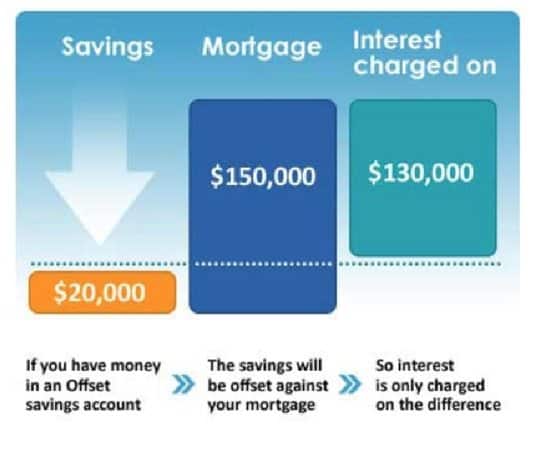
The lender thenreduces the amount on which interest is calculated by the amount in your offsetaccount. In other words, if you owe $150,000 on your home loan and you have$20,000 in your offset account your lender will only be charging you daily interest on$130,000.

The offset account will allow you to reduce the amount of interest you pay. You do this by depositing money into the offset account. These accounts will usually have unlimited free withdrawals and deposits. However, to use the offset account effectively you will need a significant amount in your account.

Some mortgage offset account strategies to consider

Diverting all income to the offset account

A mortgage offset account can be used as an all in one account to manage your cash flow. If you have an investment loan and a home loan you could direct your salary as well as any rental income into the offset account linked to your home loan which would give you the advantage of having both income sources contribute to offsetting your home loan.

Using a credit card for living expenses and an offset account

Some people also swear by putting all their living expenses on a credit card for the month so that the offset account balance remains as high as possible for most of the month. They then clear their credit card debt once a month from the offset account funds. Some lenders have an automatic sweep function to allow this to be done automatically. By doing this your salary and other income sitting in the mortgage offset account works for you to reduce your interest bill for the month. When you make your regular principle and interest repayment more of the payment then goes towards paying the principle (as you have saved a bit of interest).

Owner occupied property to become investment property

Many first-time buyers purchase properties with the intention to turn them into investment properties in the future when they upgrade to a larger or better property. In their circumstances an effective structure would be to use an interest-only loan with a linked mortgage offset account.

The strategy would be to funnel any repayments above the minimum required on the interest-only loan into the offset account. This would do three things:

  1. Having funds accumulating in a mortgage offset account would effectively mean that the borrower would not pay any extra interest on the loan. This is as compared to a standard principle and interest loan, and provided they paid at least the difference between the interest only and the principle and interest repayments into the offset account each month.
  2. In the future when the property becomes an investment, they would have a loan for the same amount as initially borrowed and on which the interest charged would be fully tax deductible. This is opposed to if they had made repayments off the principal of the loan. This would then mean the loan balance and therefore, interest claimable would be less.
  3. Any funds accumulated in the mortgage offset account could at that point be used towards the next purchase.
    In summary, this structure works for the borrower as they have not be penalised by paying any more interest on their loan than they would have if taking a more traditional loan. And they have maximised their future tax deductibility for when their property becomes an investment.

Selling your home?

There is more to selling your home than putting up a ‘For Sale’ sign on your front lawn. Here are the first things you should check off your list to help you get the largest return from your investment and to ensure the process runs as smoothly as possible.

Choose a quality agent

Asking family and friends who have purchased or sold a property about their experience is a great way to ensure the agent you’ve enlisted will provide quality service. “A website and promotional material will always highlight the agent in the best possible way, but word of mouth and past client reviews will reveal so much more.”

Make sure the agent specialises in your area and is someone you feel comfortable around as they don’t just negotiate prices on your behalf, they also act as a mediator and represent you as a vendor.

Prepare the paperwork

Getting together all the documents required is a tedious yet necessary part of the process. Before a property can be marketed for sale, your agent requires a copy of the Contract of Sale from your legal representative,become involved to ensure all the paperwork is prepared in a timely manner to see the process runs smoothly.

Don’t take things personally

Remember this is a business transaction; don’t feel insulted if you receive feedback on the property that doesn’t match how you feel about your home. To ensure you come out with the best deal, remove all emotion and think of your house as a commodity.

Your property won’t sell itself

Thinking that your home will sell itself can be a costly mistake. Despite how much you like the way you have it set up, furniture, flooring and painting changes can make a big difference to the property’s wider appeal, and marketing it widely can increase the competition and, therefore, the price. Engage with your reals estate agent to find out their proposed marketing strategy in presenting your property in its best light. Trusting your agent’s strategy should help secure the best financial result.

Speak to your mortgage broker early in the process

If you are making a decision to sell, speak to your mortgage broker to ensure that your plans after selling – whether they are buying a similar property, upgrading or building – are actually feasible.

There is nothing worse than selling your home and then not being able to achieve what you had set out to do.

Surround yourself with a good team

When all of the people in your network, including your mortgage broker, solicitor/conveyancer and real estate agent, communicate effectively, you should be blissfully unaware of any minor issues that pop up during the course of the sale.

Mortgage Finance Association of Australia (MFAA) accredited finance brokers must meet the highest industry standards, so they will be able to refer you to a great agent and other professionals that will help make the home selling process flow with minimal stress.

Deposit bond

A deposit bond is a tool that, upon agreement with a vendor, can replace the requirement of a cash deposit when purchasing a property.

This can be a relatively cheap method of initiating the purchase of a property usually without the need to liquidate your other assets. The cost of a bond can vary depending on transaction complexity and the term being sought. In a simple transaction, it is likely to be approximately 1.3% of the amount of the deposit. For example, for a deposit guarantee to the value of 10% of a property price for an individual purchasing an established property in NSW and repaying that guarantee within 6 months on a $50k deposit for a property purchase of $500k, the fee will be about $650. ($50,000 X 1.3%).

Your mortgage broker can assist you arrange the deposit bond, which when approved is issued by an insurer to the vendor of the property for either the full or partial deposit required. At settlement, the purchaser must pay the full purchase price including the amount of deposit. At this point, the deposit bond becomes void.

If the purchaser fails to complete the purchase of the property, the vendor is able to give the deposit bond to the insurer who will provide them the entire value of the deposit bond.

The insurer will then seek reimbursement of the deposit bond from the purchaser.

Deposit bonds are generally a fair bit cheaper than a short-term loan, but it’s important to talk to a mortgage broker to compare the two, taking into account your requirements and objectives and your financial situation.