
Mortgage offset Accounts
Are mortgage offset accounts a good idea?
Firstly, a mortgage offset account is a savings product not a loan product, so we are not permitted toadvise you whether they are a good idea for you or not (as they fall under the investment adviceumbrella). We can however explain how an offset account works.
If you have a home loan you can consider using an offset account.
If the purpose of the offset account is just to save a bit ofinterest and you have no intention in ever investing, then by all means weigh up the cost ofhaving the account over a more no-frills product.
What is an offset account?
An offset home loan, a mortgage offset account, an offset account or an interest offset account are all interchangeable phrases. Essentially, they are all terms used to describe a home or investment loan that has an interest offset account linked to it.
Any funds that aredeposited into the interest offset account are “offset” against the loan.
The lender thenreduces the amount on which interest is calculated by the amount in your offsetaccount. In other words, if you owe $150,000 on your home loan and you have$20,000 in your offset account your lender will only be charging you daily interest on$130,000.
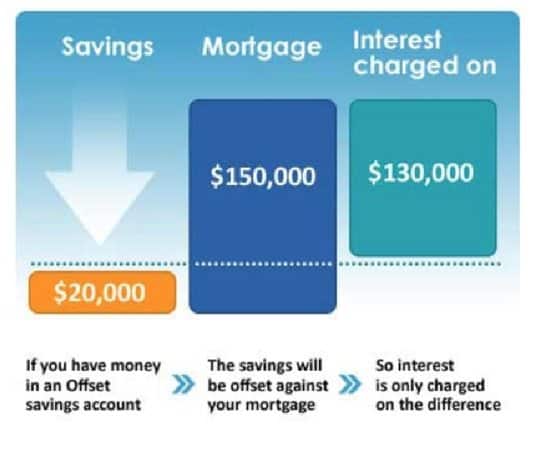
The offset account will allow you to reduce the amount of interest you pay. You do this by depositing money into the offset account. These accounts will usually have unlimited free withdrawals and deposits. However, to use the offset account effectively you will need a significant amount in your account.
Some mortgage offset account strategies to consider
Diverting all income to the offset account
A mortgage offset account can be used as an all in one account to manage your cash flow. If you have an investment loan and a home loan you could direct your salary as well as any rental income into the offset account linked to your home loan which would give you the advantage of having both income sources contribute to offsetting your home loan.
Using a credit card for living expenses and an offset account
Some people also swear by putting all their living expenses on a credit card for the month so that the offset account balance remains as high as possible for most of the month. They then clear their credit card debt once a month from the offset account funds. Some lenders have an automatic sweep function to allow this to be done automatically. By doing this your salary and other income sitting in the mortgage offset account works for you to reduce your interest bill for the month. When you make your regular principle and interest repayment more of the payment then goes towards paying the principle (as you have saved a bit of interest).
Owner occupied property to become investment property
Many first-time buyers purchase properties with the intention to turn them into investment properties in the future when they upgrade to a larger or better property. In their circumstances an effective structure would be to use an interest-only loan with a linked mortgage offset account.
The strategy would be to funnel any repayments above the minimum required on the interest-only loan into the offset account. This would do three things:
- Having funds accumulating in a mortgage offset account would effectively mean that the borrower would not pay any extra interest on the loan. This is as compared to a standard principle and interest loan, and provided they paid at least the difference between the interest only and the principle and interest repayments into the offset account each month.
- In the future when the property becomes an investment, they would have a loan for the same amount as initially borrowed and on which the interest charged would be fully tax deductible. This is opposed to if they had made repayments off the principal of the loan. This would then mean the loan balance and therefore, interest claimable would be less.
-
Any funds accumulated in the mortgage offset account could at that point be used towards the next purchase.
In summary, this structure works for the borrower as they have not be penalised by paying any more interest on their loan than they would have if taking a more traditional loan. And they have maximised their future tax deductibility for when their property becomes an investment.